
Ice Crusher / Ice Slinger
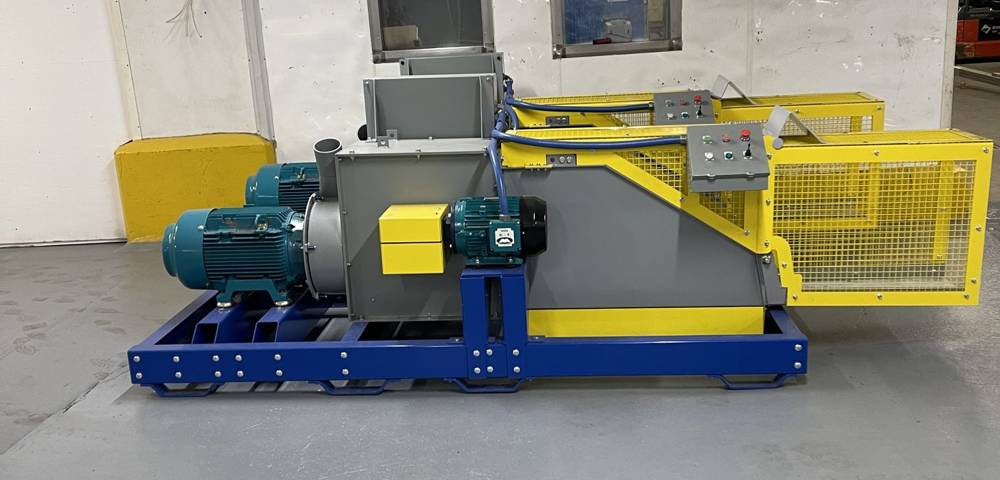
Designed by Groupe Glascold Inc. together with a mechanical engineer and built in Quebec, this system combines an ice crusher, a feed table, and an ice delivery pipe. Some people call this machine an ice slinger; others call it an ice crusher. The operator uses a forklift to carry the 300 lb (136 kg) ice blocks four at a time and sets them on the stainless steel feed table, which holds up to eight. The blocks then enter the machine one at a time, and each is crushed in 13 to 20 seconds, depending on the output required. The ice is blown into the stainless steel ice delivery pipe, which carries it straight into the mixer or, through a purpose-built nozzle, into the truck.
Groupe Glascold Inc. also makes the ice blocks, which you can pick up at our plant in Saint-Jean-sur-Richelieu, Quebec, on the South Shore of Montreal.
Videos
Ice Blocks vs. Bagged Ice
Ice Crusher Test for a Customer
Ice Crusher Test
Ice Crusher Loading a Concrete Mixer
Why an Ice Crusher?
Ice crusher: The crushed ice blends into the batch during mixing, which is when heat transfer takes place. It takes just one operator, and the ice is counted in 300 lb (136 kg) blocks. The machine delivers about 25 to 30 tons of ice per hour. Here is how this method compares with the other ways of cooling concrete.
Water chiller: It produces water at about 39°F (4°C); in a concrete plant, that water lowers the concrete temperature by only 2 to 5°F (1 to 3°C).
Liquid nitrogen (LN2): Liquid nitrogen is stored in a cryogenic tank, which means rental, installation, and removal costs. It is injected into the truck mixer drum through a lance mounted on a structure that each truck has to pull under. Because of the asphyxiation and cryogenic burn hazards, a safety perimeter must be set up around the installation. Research by the University of Texas at Austin for the Texas Department of Transportation (report 0-5111-1) looked at the effect of liquid nitrogen on truck mixer drums. According to the report, producers cooling with liquid nitrogen have seen cracks appear in the drums of some trucks, which had to be taken out of service for welding; one drum even shattered and had to be replaced (chapter 8). Temperatures measured during injection drop below 0°F (-18°C), and the report concludes that drums will remain exposed to cracking with the steel they are made of (chapters 8 and 9). The ice crusher, by contrast, needs neither a tank nor a safety perimeter.
Bagged ice: Plan on a crew of four or five people to keep up the pace. They have to unload the pallets from the trailer, open the bags by hand, empty them, count them so that the right amount of ice goes into each load, and then pick up the empty bags so they do not end up as litter. To match the ice crusher’s output, they would have to open about 25 bags a minute, at 35 lb (16 kg) each. Over the course of a day, a counting error is almost inevitable: too much or too little ice puts the slump or the temperature out of spec, which can cost one or two loads of concrete. Opening bags from morning to night is hard work and not very safe. With the ice crusher, the operator counts blocks, not hundreds of bags.
Ice Block Supply
A project may call for an ice crusher, for ice, or for both. A large project may also call for a second source of ice alongside your regular supplier. In each case, Groupe Glascold Inc. can supply the ice blocks.
We are an ice manufacturer, not a reseller. Our ice is made solely for concrete cooling. We do not sell retail ice, and we sell full truckloads only. Our 300 lb (136 kg) blocks are sized for the ice crusher, and each block is weighed individually. You can pick them up at any time at our plant in Saint-Jean-sur-Richelieu, Quebec, on the South Shore of Montreal.
A number of concrete plants in New York State, Massachusetts, Connecticut, New Hampshire, New Jersey, Pennsylvania, Ontario, Nova Scotia, and New Brunswick can get their ice blocks from us.
Made in Quebec, our ice blocks currently qualify under the United States-Mexico-Canada Agreement (USMCA) and enter the United States tariff-free. Crossing the border is very simple: you work with a customs broker, and Groupe Glascold Inc., as the producer, gives you a certification of origin for the ice.
Our pricing is highly competitive: making ice takes a great deal of electricity, and our electricity cost is low. That electricity is also clean: more than 99% of the electricity generated in Quebec comes from renewable sources, which can help reduce the environmental footprint of your project.
Groupe Glascold Inc. supplied all the ice used to cool the concrete for the Samuel De Champlain Bridge, which spans the St. Lawrence River in Montreal, and for the Réseau express métropolitain (REM), the light rail system serving the Montreal area. We are the sole ice supplier for the new Île-d'Orléans Bridge, under construction between Quebec City and Île d'Orléans, a project worth more than C$2.7 billion. Our ice crushers are on that job site. We also supply all the ice for two wind farms under construction in Quebec: Madawaska and Des Neiges.
Email us at cloutiery@glascold.com and tell us what you need. To learn more about us, visit our website at www.glascold.com.
No Belts
Every drive on the machine was chosen to eliminate belts. Belts are still found on the other machines on the market, which are built the way they were 50 years ago.
- The crushing mechanism is driven by a 7.5 hp motor through a gearbox, instead of a belt and pulley.
- The blower wheel in the blower mechanism is driven directly by a 40 hp motor.
- The blocks are fed to the ice crusher by a chain driven by a 1 hp motor through a gearbox.
- The motors start one after another, which reduces inrush current.
- Our motors are not oversized: 40 hp for the blower wheel, 7.5 hp for the crushing mechanism, and 1 hp for the block feed drive. The complete unit draws about 80 amps at 480 volts, or about 60 amps at 600 volts. Our competitors fit their ice crushers with 75 hp and 10 hp motors, both with belt drives, which calls for more than 100 amps. On their machines, the block feed drive is still adjusted with a manual belt tensioner. It is easy to check: search for “Ice Slinger” online, then compare the machines.
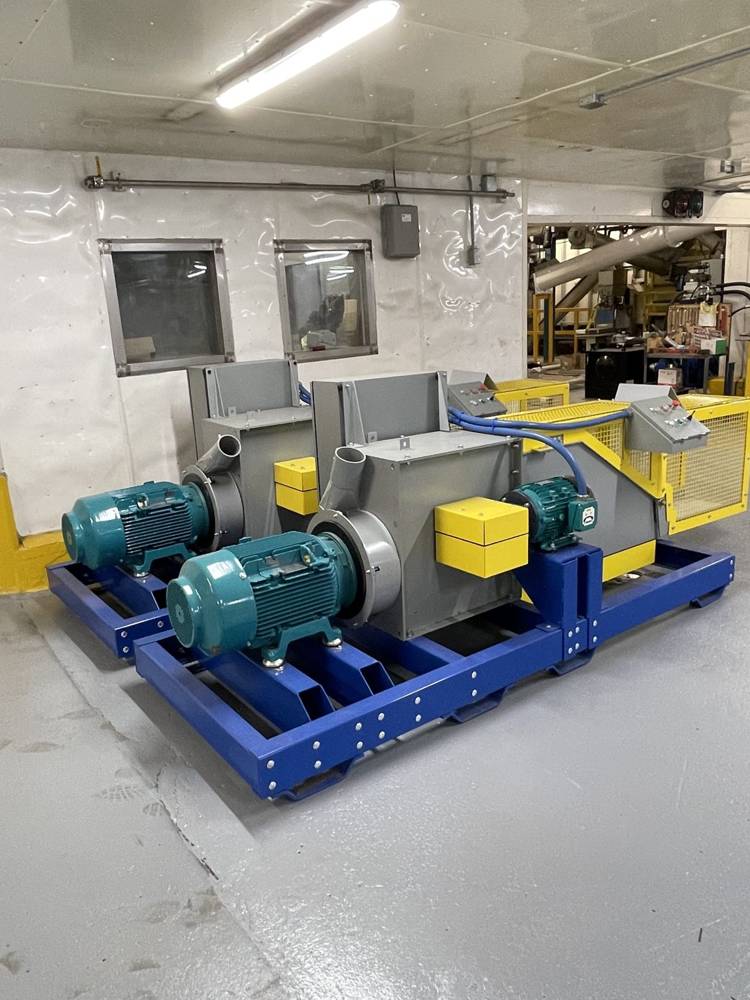
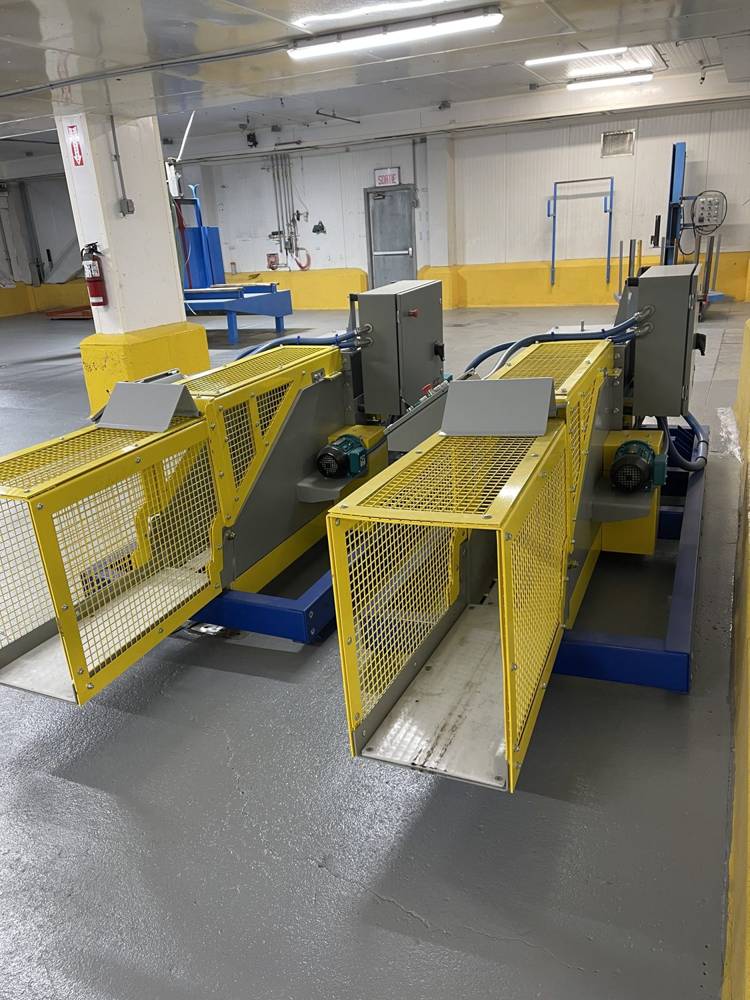
One Operator Is All It Takes
The operator sets the blocks on the feed table with the forklift and runs the machine from the control console.
New: On 2026 models, a remote control pendant is available as an option. We added it to improve working conditions for the operator, who can then feed the ice crusher without getting off the forklift. The remote control pendant also has an emergency stop.
- Safety guards on all moving parts.
- Emergency stop on the control console and on the main panel.
- “Ready” light that comes on when the machine is powered.
Designed for the People Who Run It
Some ice crushers still in service were designed decades ago and rely on belts that need constant attention. That was the standard of another era. Work practices have changed, and occupational safety and health requirements are far stricter than they were 50 years ago.
That is why we completely rethought the machine to suit today’s needs: there is not a single belt on our ice crusher. The drives sit behind safety guards, and there is an emergency stop on the control console and another on the main panel. The main panel and the control console are both UL 508A certified for the United States or CSA certified for Canada. The 300 lb (136 kg) blocks are set on the feed table with the forklift, never by hand.
For a company, choosing a machine like this is one more way to look after its people.
Maintenance-Free, Easy to Move, and Covered by a Two-Year Warranty
All components are sealed and require no maintenance.
Crushing Teeth
Each tooth on the crusher wheel is bolted on with a locknut rather than held by a simple pin—a solid attachment that does not work loose.
Bladed Blower Wheel
Extensive airflow testing produced the best match between the blower wheel and its 40 hp motor.
UHMW Contact Surfaces
Wherever a block travels, it rides on UHMW, never on steel. The blocks still slide just as easily toward the ice crusher after a long shutdown—no rust, nothing to pry loose.
Vibration Isolation
All motors sit on rubber vibration isolation mounts selected by a firm that specializes in this field. The firm sized each mount for the motor’s weight, power, and rotational speed, so that vibration is absorbed before it reaches the frame.
Forklift Handling
Two fork pockets are built into the ice crusher’s frame, one on each side of its center of gravity. The forks slide in and the machine stays balanced on them, so it can be moved without tie-downs, slings, or any adjustment beforehand. It can be lifted from the right or from the left.
Two-Year Warranty
All components of the ice crusher are covered. The warranty applies to normal use of the machine; it does not cover damage caused by accident or negligence.
Parts in Stock
All parts are kept in stock. Because we build these machines, we always have the components for three or four ice crushers on hand. Parts can be shipped at any time by the carrier of your choice: FedEx, UPS, DHL, or another.
The Feed Table
You can see the feed table in action in the “Our Method” section of our website.
How it works:
- The operator sets the 300 lb (136 kg) blocks on it with the forklift, four at a time; the table holds up to eight.
- 4 × 10 ft work surface covered with UHMW: the blocks slide toward the ice crusher one at a time.
- Retaining rails on each side; access is from the right or the left, whichever you prefer.
How it ships:
- Shipped assembled or disassembled, depending on the distance. Disassembled, it takes up far less trailer space, which lowers shipping costs. It goes together easily, with no welding, using the carriage bolts supplied.
- We supply the complete frame; the 4 × 10 ft UHMW sheet can be included in the shipment, or you can buy it locally to reduce shipping costs.
Engineered, Not Improvised
We did not start from an existing machine. We designed everything from scratch, as part of a structured research and development program built around the real needs of a concrete plant: operator safety, labor requirements, maintenance, and reliability.
- Complete 3D model of every component before fabrication.
- Finite element stress analysis of all load-bearing parts, including the base, the feed table, and the pipe supports.
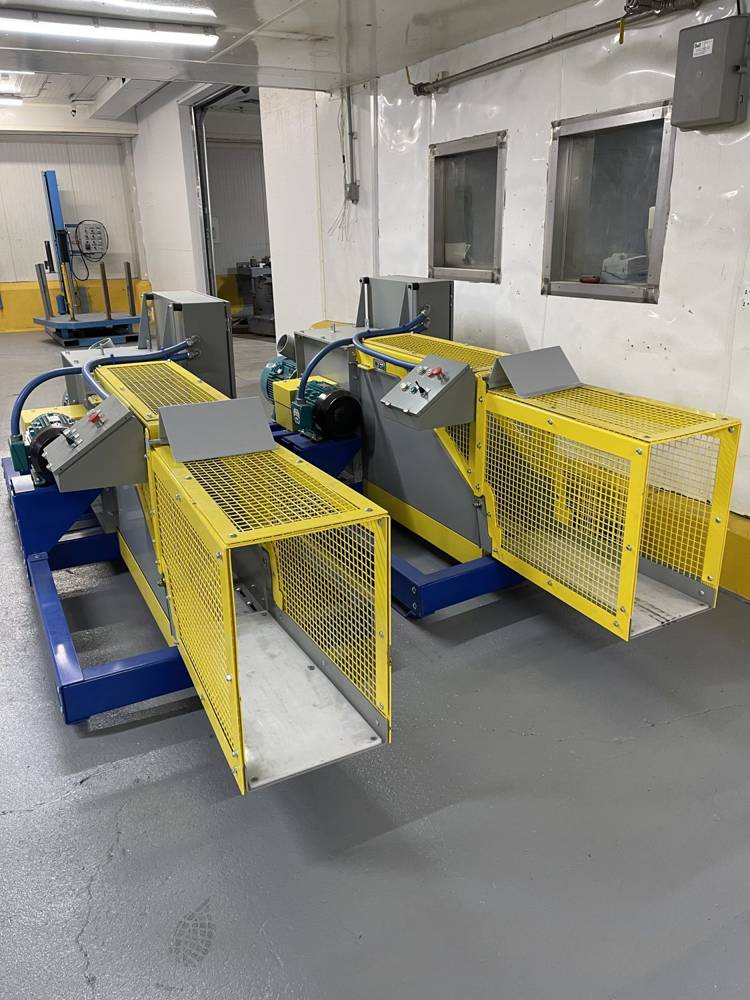
- The two ice crushers in the photo were built from the same drawings and proven in continuous production.
Performance
The figures below come from on-site testing combined with engineering calculations. The feed rate is adjustable. Each block is crushed in 13 to 20 seconds, depending on the ice output the plant needs.
Reach with a Straight 4 in. Pipe
| Pipe angle | Pipe length | Height reached |
|---|---|---|
| 30° | 50 to 70 ft (about 15 to 21 m) | 25 to 35 ft (about 8 to 11 m) |
| 45° | 40 to 60 ft (about 12 to 18 m) | 28 to 42 ft (about 9 to 13 m) |
Reach calculated for a straight pipe with no elbows.
Specifications
| Crushing mechanism | 7.5 hp motor with gearbox. |
|---|---|
| Blower mechanism | 40 hp motor at 1,750 rpm, direct drive. |
| Block feed drive | Chain driven by a 1 hp motor through a gearbox. |
| Motor starting | Sequential, to reduce inrush current. |
| Vibration isolation | All motors sit on rubber vibration isolation mounts. |
| Power supply | 480 volts, three-phase, about 80 amps (United States), or 600 volts, three-phase, about 60 amps (Canada), for the complete unit. |
| Main panel and control console | UL 508A certified (United States) or CSA certified (Canada); fully enclosed, with labeled wiring. |
| Controls | Main panel: power connection, main disconnect, and emergency stop. Control console: block forward and reverse controls, “Ready” light (on when the machine is powered), and emergency stop. Optional remote control pendant: duplicates the control console functions, including the emergency stop, so the operator does not have to get off the forklift. |
| Crushing time | 13 to 20 seconds per block. |
| Ice delivery pipe | 4 in. diameter, type 304 stainless steel, sections up to 20 ft. |
| Output | More than four blocks per minute; about 25 to 30 tons per hour with steady feeding. |
| Crushed ice particle size | About 1/8 in. (3 mm). |
| Feed table | 4 × 10 ft UHMW surface, holds up to eight blocks, bolted stainless steel frame. Shipped assembled or disassembled. |
| Feed table deck | White UHMW polyethylene sheet, 4 × 10 ft and 1/2 in. thick, chosen to help the blocks slide to the ice crusher. If the shipping distance is long, you can buy it from a supplier in your area and save on shipping costs. |
| Weight | About 2,300 lb (1,045 kg), ice crusher only, without the feed table. |
| Base dimensions | 112 in. long by 45 3/8 in. wide (2.84 m by 1.15 m). |
| Construction | Ice crusher available in two versions: stainless steel, or steel with baked powder coating in your company colors, at no extra charge. |
Two Versions
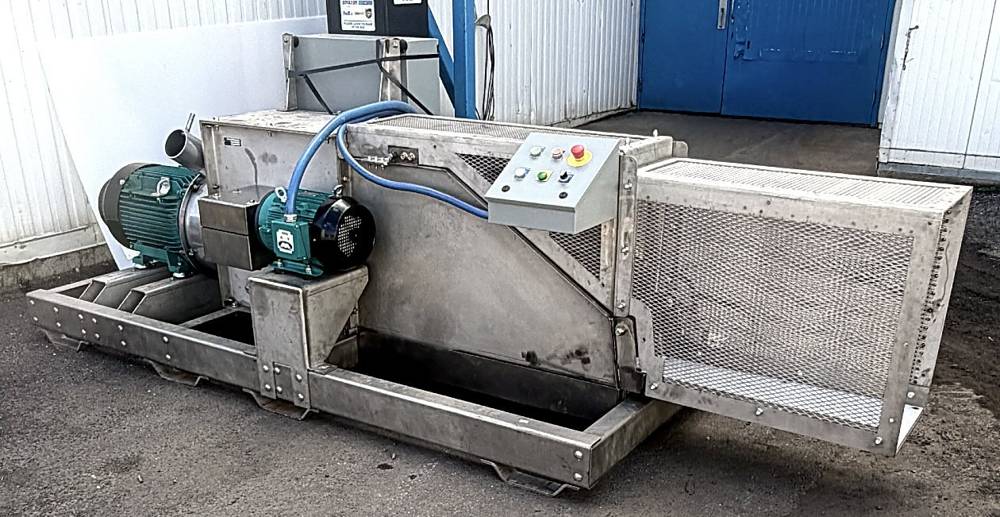
Stainless Steel
For maximum corrosion resistance and easy cleaning.
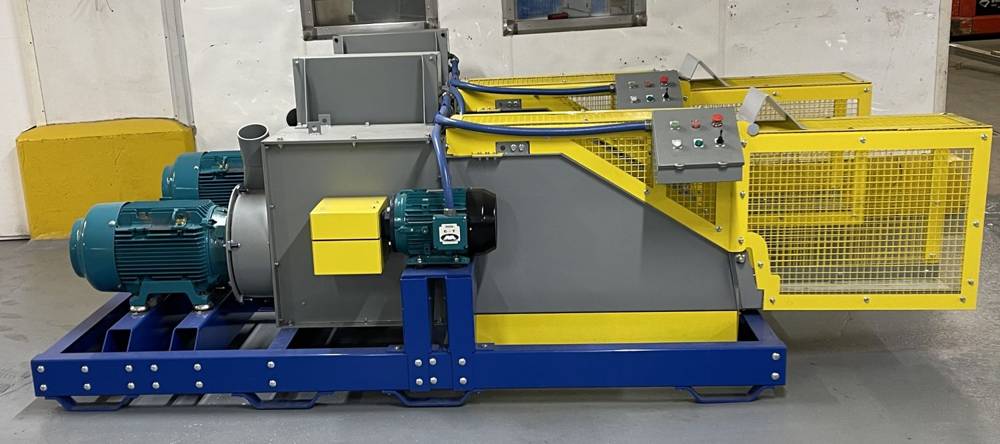
Steel with Powder Coating
In your company colors, at no extra charge.
Meets U.S. and Canadian Requirements
The ice crusher is built at our factory in Saint-Jean-sur-Richelieu, Quebec. Its design meets the requirements of both countries: 480 volts and UL 508A certification for the United States, 600 volts and CSA certification for Canada.
Lead Time
Each ice crusher is built to order for the required voltage. Allow a minimum lead time of 90 days from order confirmation.
Proven on Major Projects
For 15 years, Groupe Glascold Inc. has supplied concrete cooling equipment and solutions for major construction projects in Canada. These include the Samuel De Champlain Bridge, the Réseau express métropolitain (REM), and several wind farms in Quebec and Ontario. Our machines crushed all the ice used to cool the concrete for the Samuel De Champlain Bridge and the REM, for both precast elements and cast-in-place concrete. They did the same for a large share of Quebec’s wind farms. Then there are all the projects our customers have completed with the ice crushers we sold them. These machines are used wherever concrete has to be cooled: wind turbine foundations, bridges, dams, light rail systems, and other mass concrete structures.
Tested on Site, Bought the Same Day
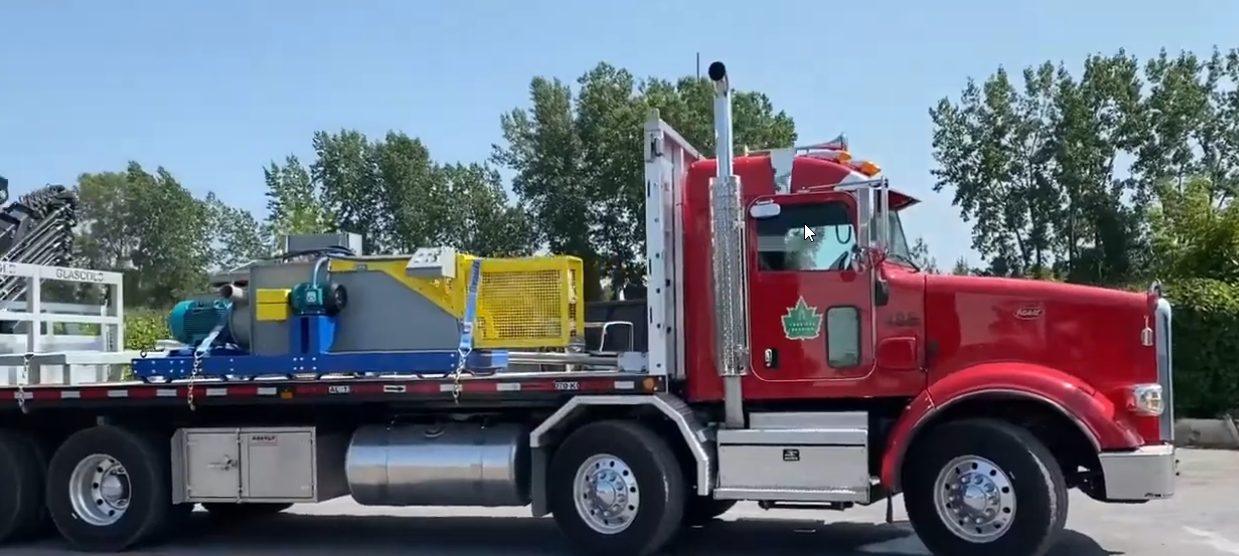
After testing an ice crusher at our facility, Luc Ouimet, President of Carrière Bernier, quickly saw what this method could do for his operations. Convinced by the machine’s efficiency, he bought it on the spot. Less than an hour later, a truck was on site to pick it up for installation at the company’s concrete plant.
Ice Crusher Questions and Answers
What is an ice crusher for concrete cooling?
It is an industrial machine that breaks blocks of ice into fine fragments. It has a blower mechanism and a crusher wheel fitted with crushing teeth. The Groupe Glascold Inc. machine crushes a 300 lb (136 kg) block in 13 to 20 seconds, then blows the ice through a 4 in. ice delivery pipe into the mixer or the truck. One person is all it takes to run it.
What is the ice crusher’s output?
More than four 300 lb (136 kg) blocks per minute. Output can reach about 25 to 30 tons per hour with steady feeding. The crushed ice particle size is about 1/8 in. (3 mm).
What power supply does the ice crusher need?
In the United States, 480 volts, three-phase, about 80 amps for the complete unit, with a UL 508A-certified main panel and control console. In Canada, 600 volts, three-phase, about 60 amps, with a CSA-certified main panel and control console. The motors start one after another, which reduces inrush current.
How far can the ice crusher blow the ice?
Up to 70 ft (about 21 m) through a straight 4 in. ice delivery pipe inclined at 30 degrees.
Does the ice crusher have any belts?
No, none. The crushing mechanism and the block feed drive are each driven through a gearbox, and the blower wheel is driven directly by its motor. So there are no belts to tension or replace.
How do I order an ice crusher?
Email your requirements to cloutiery@glascold.com for a quote. Each ice crusher is built to order at the Groupe Glascold Inc. factory in Saint-Jean-sur-Richelieu, Quebec, in stainless steel or in steel with baked powder coating, and it meets U.S. and Canadian requirements. Allow a minimum lead time of 90 days from order confirmation.
Where can I get ice blocks for the ice crusher?
Groupe Glascold Inc. makes 300 lb (136 kg) ice blocks at its plant in Saint-Jean-sur-Richelieu, Quebec, on the South Shore of Montreal. The ice is sold by the full truckload only, and you can pick it up at any time.
Tell Us What You Need by Email
Write to Yves Cloutier, and we will reply with full details. Quotes are free, and the price difference compared with other ice crushers may surprise you.